Vallam-613 403-Thanjavur Tamil Nadu
 principal@periyarpolytech.com
Working Days : Monday to saturday
 Vallam-613 403-Thanjavur Tamil Naduprincipal@periyarpolytech.com
Working Days : Monday to saturday
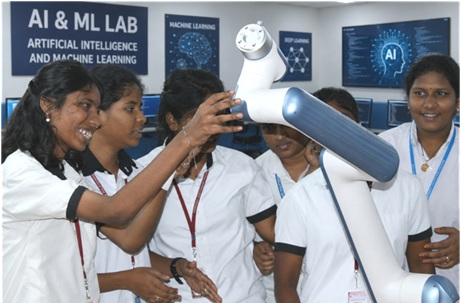
The Department of Artificial Intelligence and Machine Learning (AI & ML) was established in 2025 at Periyar Centenary Polytechnic College, Vallam, Thanjavur. The department offers a three-year diploma programme focused on AI, Machine Learning, Data Science, Python Programming, and emerging technologies. With experienced faculty, modern laboratories, hands-on training, industry-oriented projects, internships, and placement support, the department prepares students for successful careers and higher education in the rapidly growing field of Artificial Intelligence.
1. Programming Lab
2. Linux Lab
3. Artificial Intelligence Laboratory
To empower students with excellence in AI and Machine Learning for innovative and sustainable technological development.
M1: To provide quality education in Artificial Intelligence and Machine Learning through
innovative teaching and practical learning.
M2: To develop students’ technical, analytical, and problem-solving skills for industry and
research applications.
M3: To encourage research, innovation, and entrepreneurship in emerging AI technologies
and to promote ethical and socially responsible by use of Artificial Intelligence
technologies.
M4: To collaborate with industries and academic institutions for real-world exposure and
lifelong learning.
PEO1 : Our Diploma graduates will acquire strong foundational knowledge in Artificial Intelligence, Machine Learning, programming, and data analytics to solve real-world problems effectively.
PEO2 : Our Diploma graduates will pursue higher education, entrepreneurship, research, certifications, and lifelong learning to adapt to emerging technologies and industry needs.
PEO3 : Our Diploma graduates will demonstrate professional ethics, communication skills,
teamwork, leadership qualities, and social responsibility in multidisciplinary environments
1. Basic and Discipline specific knowledge: Apply knowledge of basic mathematics, science and engineering fundamentals and engineering specialization to solve the engineering problems.
2. Problem analysis: Identify and analyse well-defined engineering problems using codified standard methods.
3. Design/ development of solutions: Design solutions for well-defined technical problems and assist with the design of systems components or processes to meet specified needs.
4. Engineering Tools, Experimentation and Testing: Apply modern engineering tools and appropriate technique to conduct standard tests and measurements.
5. Engineering practices for society, sustainability and environment: Apply appropriate technology in context of society, sustainability, environment and ethical practices.
6. Project Management: Use engineering management principles individually, as a team member or a leader to manage projects and effectively communicate about well-defined engineering activities.
7. Life-long learning: Ability to analyse individual needs and engage in updating in the
context of technological changes.
PSO1: Ability to design, develop and implement Artificial Intelligence and Machine Learning solutions using modern programming languages, tools and frameworks for real-world applications.
PSO2: Ability to apply data analytics, deep learning, computer vision and natural language processing techniques to solve domain-specific problems effectively.
PSO3: Ability to analyze datasets, build predictive models and optimize intelligent systems using mathematical, statistical and computational techniques.